

The Urgency of Art Prize 2026
The Urgency of Art Prize recognises artists whose work proceeds from conviction rather than the market — art made because it needs to be made. It is not a prize for the most saleable object, the most fair-ready surface, or the longest exhibition history. It is for work that treats art as a way of thinking through the pressures of the present: ecological, social, political, and philosophical.
The Prize is open internationally and to artists at any stage of their career. We make no distinction between the represented and the unrepresented, the credentialed and the self-taught. What we look for is seriousness of purpose and clarity of vision the sense that a given work could only have been made by this artist, now, out of genuine necessity.
Selected artists are featured in The Urgency of Art Magazine and join a growing archive of practitioners working from principle rather than fashion.
The Urgency of Art Prize values necessity above all art that answers to a real pressure rather than a trend or a market gap, work that would still have been made if no one were watching. We value conceptual seriousness: thinking that is honest enough to hold a difficult question open rather than resolve it into a slogan. We value an ecological and social consciousness, a practice that reckons with the living world, with our relationships to one another, and with systems of power, extraction, and care. We value formal conviction, where idea and execution meet so completely that the work could have taken no other form. And we value independent vision — a voice recognisably the artist's own, unhurried by fairs, fashions, or algorithmic taste.
The Winners


Jiaqi Lyu
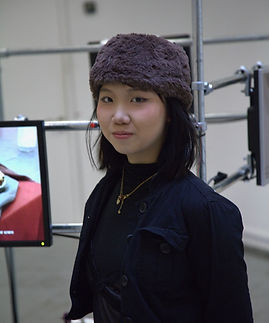%20-%20melissayunzhi.jpeg)
Melissa Yunzhi Li

Paula Rae Grundy

Sachiko Shimojo

Yaxuan Li

Sheen Ochavez

Julia Xin Zhang
Shortlisted


This Year's Winners
This year's Prize goes to seven artists: Jiaqi Lyu, Melissa Yunzhi Li, Paula Rae Grundy, Sachiko Shimojo, Yaxuan Li, Sheen Ochavez, and Julia Xin Zhang. They work across different media, at different stages, and out of very different lives, but the panel returned to each of them for the same reason: none of this work reads as made for the room it might end up in. It answers to something the artist could not put down.
We did not select for consensus; we selected for pressure. Each of these seven does something the field genuinely needs — opens a question rather than decorating an answer, and risks more than a safer version of the same work would have. Wwhat they share is not a subject but a seriousness of purpose, and a voice that is unmistakably their own. Set beside one another, they make the argument the Prize exists to make: that art proceeding from necessity, rather than from the market, is where the most urgent thinking is currently being done.
Five of the seven — Jiaqi Lyu, Melissa Yunzhi Li, Sachiko Shimojo, Yaxuan Li, and Julia Xin Zhang — were invited to show at Colour & Nature, The Chapel at Brompton Cemetery, where the work could be met in person rather than on a screen. Seeing it together confirmed what the panel had suspected on paper: that these are practices built to last, carrying the conviction of artists much further along than their careers might suggest.

Sachiko Shimojo is a Tokyo-born, London-based painter (RCA MA Painting, 2024) who works from inner reflection, turning private experience into images of quiet luminosity. Her paintings meet grief and mortality not with darkness but with colour, insisting that death, like life, is something seen in full spectrum.
We Find Our Way was selected for the courage of its tenderness. Built from a dream Shimojo had the night before a friend's death — a riverside, a ferryman, a black dog sent to guide the crossing. The painting draws together two folk beliefs, one from her homeland and one from overseas, without straining to reconcile them. The panel was moved by her refusal of the sombre palette we expect of mourning: she paints the passage in full colour because life is many colours, and death, being part of life, must be too. It is a small canvas that carries an enormous subject lightly, and that lightness is precisely its seriousness.

Paula Rae Grundy is a London/Brighton-based artist completing an MA in Painting at the Royal College of Art. After almost two decades in design and advertising, she returned to fine art; her practice treats drawing as a mode of thinking, working oil paint through linen and muslin so that surface, gesture, and cloth continually reconfigure one another.
Grundy was selected for a practice in which meaning is not depicted but arrived at through material negotiation. She works muslin as a membrane so that the image emerges through repetition and accumulation rather than being set down whole. Rather than representing memory directly, her paintings translate it, letting surface and cloth reconfigure one another until something surfaces. The panel valued the honesty of a process that thinks in the making rather than illustrating a conclusion decided in advance, and her current push beyond the wall, into the threshold between painting and object, marks a practice still genuinely searching.


Jiaqi Lyu (b. 2001, Harbin) is a painter whose work reaches back into the archives of Northeast China to make the neglected visible again. Transforming old photographs, everyday objects, and inherited memory into ghostly presences, she paints time as something porous a surface where the marginalised past can turn and meet the present gaze.
Lyu does not illustrate nostalgia; she builds a space where several times are made to coexist at once two anonymous figures from a century-old photograph of Harbin Station, a carved stone window she encountered in Canton, the spectral drift of a magpie. The panel was struck by the restraint of it: nothing is explained, and the painting is stronger for refusing to. Against this year's concerns around inheritance, loss, and who gets remembered, Window insists that recovering the obscured is not a sentimental act but an urgent one a way of holding open a question the present would rather close. It is early work carrying the conviction of a much longer practice.


Yunzhi / Melissa Li is a Chengdu-born, London-based computational artist working across interactive installation, web art, and immersive 3D. Drawing on archives, found digital material, and 3D scans, she asks how images, code, and audience interaction shape our sense of memory, identity, and place. Her work has shown at the V&A and The Photographers' Gallery.
Flickring Home was selected for treating the internet as an unstable archive of feeling rather than a neutral store of data. Li builds a navigable virtual home from images tagged "home" on Flickr between 2004 and 2015 so that the natural world enters digital memory through countless small acts of everyday image-making. The panel was drawn to how the work holds a genuinely contemporary question open: what happens to private memory when it is assembled from public images we never meant to share this way. It is technically ambitious without hiding behind its technology, and it belongs to the exact terrain that this year's concerns demand.
Xin Zhang (Julia), b. 2002, London-based, is a rope artist and cross-disciplinary practitioner and the founder of JX Studio. A UAL graduate, she centres her work on traditional Asian rope art (Shibari), integrating it with performance, digital creation, and material experimentation.
A Liturgy of Entanglement was selected for the intelligence with which it lets material think. Suspended in the chapel, a painted botanical surface is held, crossed, and partly obscured by long green ropes that stretch, sag, and answer to gravity the knots recording the hand's gestures without ever reducing to a record of human control. The panel admired how the work refuses the clean line between the organic and the manufactured: vegetation dissolves into stain and trace, entangled with the fibres that bind it. In the setting of a chapel, its suspension takes on a votive charge, proposing spirituality not as an escape from matter but as a condition of it to exist is to be held by, and responsible to, other bodies and forms of life. It is one of the most conceptually complete works in this year's field.

Yaxuan Li is an artist working across flowers and sensory experience, with a background in linguistics and applied linguistics. She treats organic materials as carriers of emotional and symbolic meaning rather than decoration, using the fragility and temporality of flowers to explore presence, transformation, and modes of communication that move beyond language.
Blooming Flame and a Sweet Dream was selected for the unusual rigour behind its softness. Li brings the tools of discourse analysis to floral practice, treating flowers not as ornament but as a language one whose structures shape perception the way grammar shapes speech. The panel was struck by how the work sits between analysis and intuition, asking to be felt as much as understood. Its embrace of temporality and fragility the fact that the material will not hold still is not a flaw the work manages but the very thing it is about. It is a genuinely interdisciplinary practice that earns the word rather than borrowing it.
Sheen Ochavez is a London-based, Philippine-born painter (MA Painting, Royal College of Art) whose work maps the shifting space between cultures, identities, and histories that defines the migrant experience. Taking pre- and post-colonial Philippine painting and murals as points of departure, she works figuration and abstraction against one another spontaneous, fracturing lines and a palette drawn from memory to make visible the layered, often uncomfortable realities of the postcolonial psyche.
Ochavez was selected first for the sheer force of her surfaces. Her palette pinks, reds, blues, purples, ochres, all rooted in the colours of the Philippines carries real emotional and atmospheric weight, and the visual impact is immediate: figures emerge and dissolve, continuous lines fracture the space, and any sense of stability is deliberately interrupted. But the panel valued that this vibrancy is never decorative. Drawing on Homi Bhabha's notion of the "third space," Ochavez uses colour as both anchor and connector, the place where hybridity becomes generative and identities overlap, collide, and recombine into new forms. The work reckons directly with how a colonial past continues to haunt the present, yet it refuses to let otherness read as marginal — it makes it expansive instead. It is painting that arrives as pure visual charge and holds up entirely to the thinking behind it: a reclaiming of space, a rewriting of origin.
