

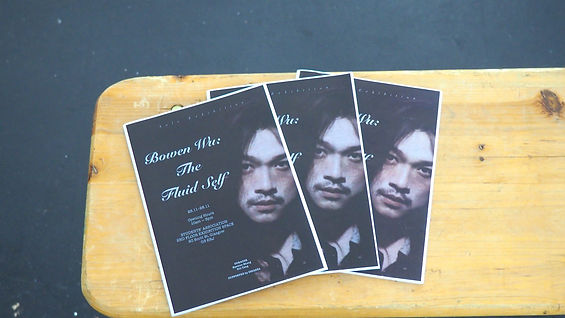

The Fluid Self
A solo exhibition of
Wu Bowen
Glasgow, UK | 25–28 November 2025
The Fluid Self, a solo exhibition by artist and composer Wu Bowen, recently concluded in Glasgow, drawing attention from the city’s art community, students, and educators. Through spatial experimentation and cross-media practice, the exhibition examines the shifting nature of identity, perception, and space within contemporary contexts of migration, offering an experience that is both immersive and critically reflective.
Bringing together sound, moving image, installation, newly designed digital instruments, and performative elements, the exhibition unfolds as a continuously transforming spatial environment. The oscillation between the stage and the white cube functions not simply as a display strategy, but as a conceptual device—pointing to changing conditions of visibility, spectatorship, and self-positioning. Space is treated as a fluid interface, one in which memory, emotion, and consciousness are constantly forming and dissolving.
During the exhibition, John Thorne, Sustainability Coordinator at the Glasgow School of Art, reflected on the work’s relevance to contemporary relationships between humans, nature, and digital technology. He wrote:
As at many times in human existence, we stand at the cusp of something new, where humans have to make sense of sharing a World they once dominated, with an increased sense of the need to protect nature, and with an emerging intelligence which is not human or alien, but digital AI and created by us.
This is and will profoundly affect us as a species. We have no firm vision of who we are becoming, even if we will get a chance to become, or how we can fit with nature and survive, and how digital forces will help or hinder us.
The facts of what is happening are often clouded by conspiracy theory, rampant capitalism and greed led by a new technocracy, within a nature we can’t emotionally connect with to protect, and no vision or path – leading to coping behaviors like denial, deliberate ignorance or willful disconnectedness.
Wu’s work seeks to connect us back, to ourselves, each other and to question our interactions and our lives with nature and technological life. Can we make use of digital interactions to help us connect back to nature, to see it through different eyes, to find a role and friend in AI; can digital interventions and can data be put to new and better uses?
We need to see through differing lens, the fish, the interactive and responsive instruments Wu makes, alongside cultural and analogue musical instruments – which frees us in the playing and exploration of the works to discover new creative forces. And through this to connect differently, to allow us to interact and be interacted on – something that we need to better appreciate and allow if we’re to see nature for what it is, and where digital will fit in.
We need this emotionally connection, that joy and serious conversation that comes from these works; humans are disconnecting fast, with digital systems fitting between us and wider nature. It feels like this important work is giving these assumptions and ways of living a lively mix, asking us to challenge assumptions and culture life, to consider what might be possible in the future, and to start working with each other, with AI, within the analogue and digital Worlds, to find that future vision and thought.


Sadko

